

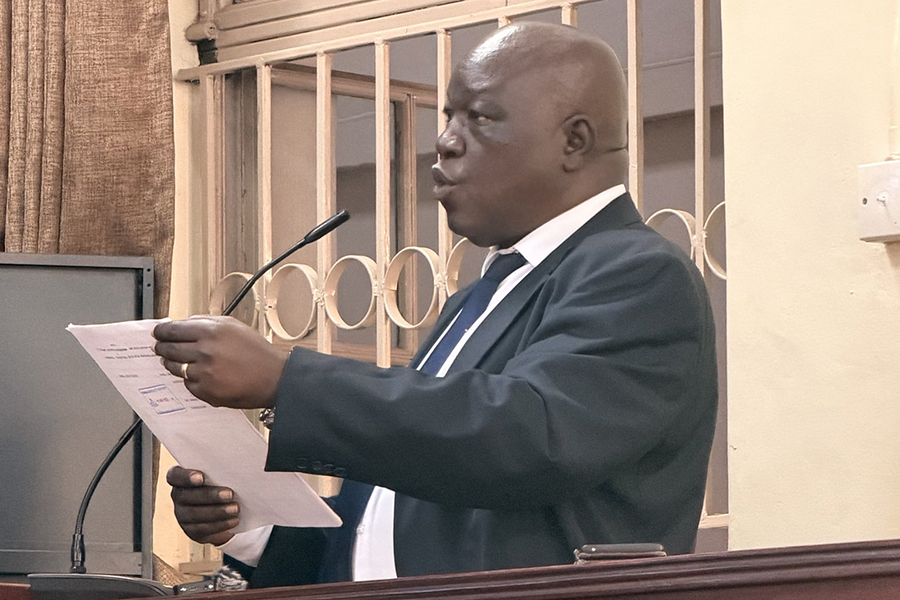
A senior forensic pathologist on Thursday told the High Court that the possibility that businessman Henry Katanga was shot and killed by his wife, Molly Katanga, is “extremely slim and highly unlikely”.
Instead, Dr Sylvester Onzivua told the court presided over by Justice Rosette Comfort Kania that the evidence points to a homicide-suicide scenario in which the deceased assaulted his wife and believing she ws dead, turned the gun on himself.
Dr Onzivua, a former head of Kampala’s City Mortuary and one of Uganda’s most experienced forensic pathologists, launched a sweeping scientific attack on the prosecution’s postmortem findings, describing the state’s report as “a very dangerous postmortem report that couldn’t have passed peer review.”
The pathologist, the first defense witness in the closely watched trial at the Criminal Division of the High Court, testified that the forensic evidence relied upon by prosecutors to charge Molly Katanga with murder was fundamentally flawed and contradicted established principles of forensic pathology and ballistic science.
“This case before court is not a homicide,” Dr Onzivua testified.
“The postmortem forensic evidence in this case points to suicide unless proven otherwise. The blood splatter pattern is consistent with the facts that the deceased battered the victim then sat on the bed and shot himself.”
The testimony marked a dramatic escalation in the defense’s attempt to dismantle the prosecution’s central theory in one of Uganda’s most high-profile criminal trials.
Molly Katanga is jointly charged with her two daughters, a domestic worker and a family nurse over the November 2, 2024 death of her husband at the couple’s residence in Mbuya, a Kampala suburb.
Henry Katanga was found dead in the family bedroom with a gunshot wound, while Molly Katanga was discovered unconscious nearby with catastrophic injuries that later required emergency brain surgery.
Medical evidence presented earlier in the trial showed she suffered severe head trauma, multiple fractures to her arms and fingers and extensive deep tissue injuries. One of her fingers was later amputated.
The prosecution has maintained that Henry Katanga was killed and has relied heavily on forensic evidence suggesting the bullet entered through the left side of his head and exited through the right ear — a trajectory prosecutors argued weakened the possibility of suicide because the deceased was right-handed.
But Dr Onzivua completely rejected that conclusion.
Using a 50-slide PowerPoint presentation, anatomical illustrations and postmortem photographs, the veteran pathologist walked the court through firearm mechanics, bullet trajectories and characteristics of entry and exit wounds.
Dr Onzivua holds a Bachelor of Medicine and Surgery degree from Makerere University obtained in 1993, a Master of Medicine in Pathology earned in 2003 and a postgraduate diploma in forensic medicine from the Colleges of Medicine of South Africa obtained in 2005.
He also trained in forensic anthropology in Durban and worked at Mulago Hospital under Makerere University’s Department of Pathology before heading the City Mortuary between 2005 and 2013.
He told court he has testified in numerous criminal prosecutions, including cases before military courts.
Court proceedings began with tense exchanges between defense lawyer Elison Karuhanga and Chief State Attorney Jonathan Muwaganya over which postmortem report the witness could rely on.
The disagreement forced Justice Kania to summon both legal teams to her chambers for more than two hours before proceedings resumed.
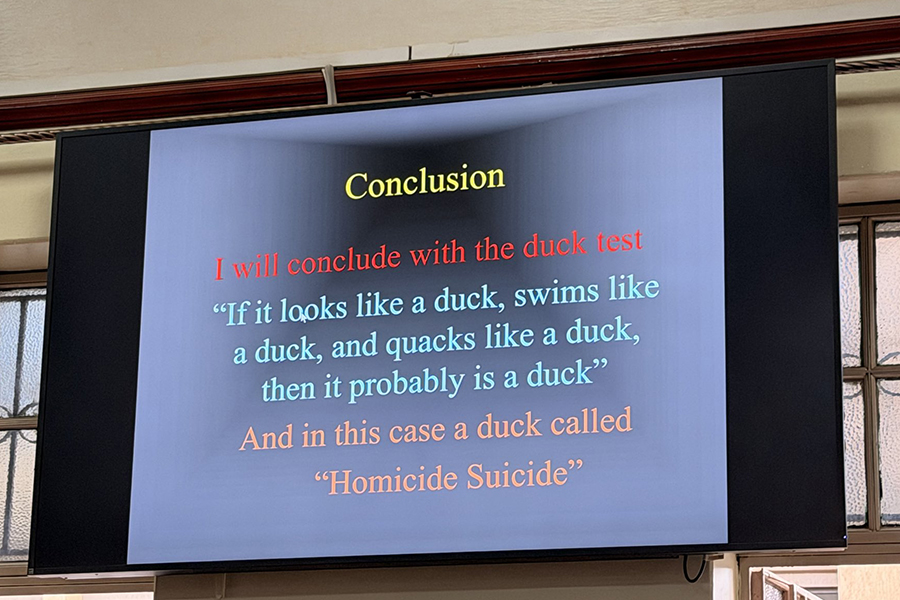
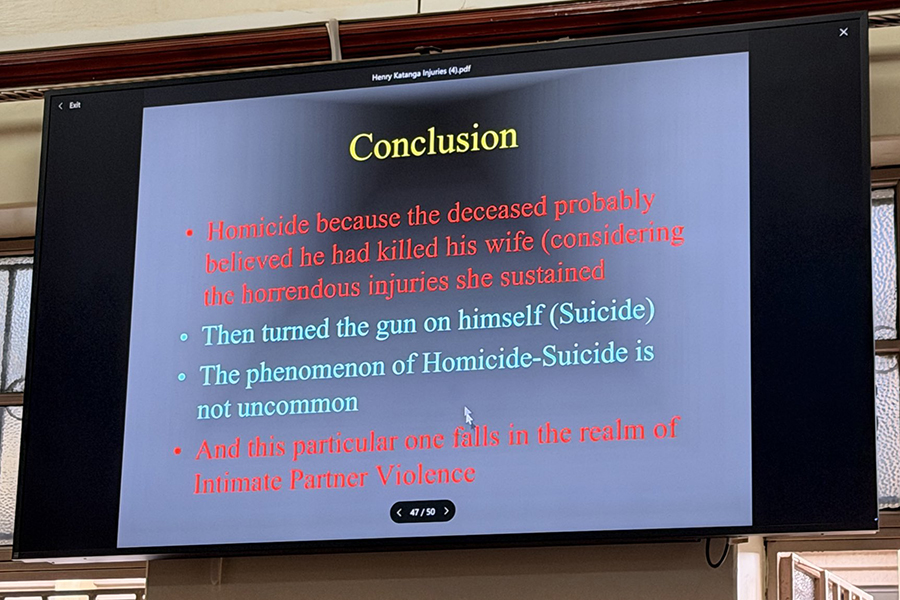
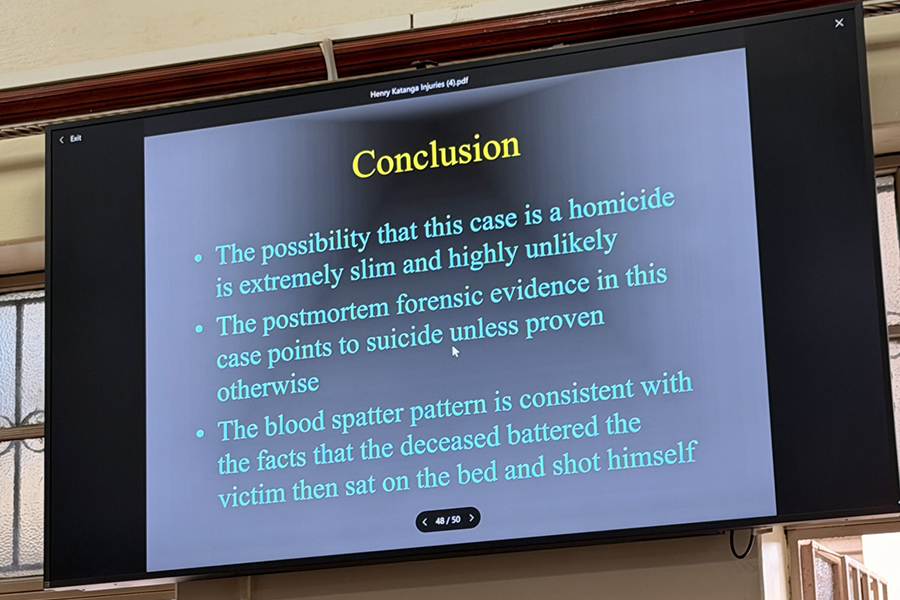
Once back in open court, Dr Onzivua took on what observers described as the role of a forensic science lecturer, carefully explaining how close-range gunshot wounds behave and why he believed the prosecution’s interpretation was scientifically indefensible.
He said the state pathologists wrongly concluded that the wound on the left side of Henry Katanga’s head was the entry wound despite lacking the defining characteristics of close-contact gunfire.
“There’s no tattooing, no blackening, no muzzle imprint on a close-contact bullet entry wound,” he testified.
“So how, how, hoooow would they have called this an entry wound in the absence of blackening, tattooing or muzzle imprint? There’s no scientific basis of calling the wound on the left an entry wound.”
Instead, he argued that the right side of the deceased’s head displayed all the classic signs of bullet entry.
“A comparison of the right and left ear shows blackening on the right and none on the left,” he testified.
“On the contrary, the external features of the wound on the right side are those of an entry gunshot wound.”
Dr Onzivua pointed to tearing around the right ear caused by explosive gases emitted during close-contact discharge and said prosecution pathologists failed to document what he described as the “true entry wound.”
“There’s blackening,” he explained while referring to enlarged postmortem photographs.
“And there’s a small true entry wound inside there that my colleagues did not document.”
Defense lawyer Elison Karuhanga then asked: “So that small hole is the entry wound?”
“That is the entry wound, my Lord,” Dr Onzivua replied.
The witness also challenged measurements used in the prosecution report.
“The wound on the right was stated to be 5cm by 3cm and this was described as an exit wound,” he testified.
“The entire dimensions of the ear were taken and then stated to be the dimensions of the exit wound. This, scientifically, is not correct.”
He further testified that ballistic evidence from the crime scene itself contradicted the state’s theory.
“The bullet mark through the mosquito net and on the ceiling indicates that the bullet travelled upwards after being fired,” he said.
“The wound on the left side of the head is higher than that on the right side and this confirms that the bullet travelled from right to left.”
That conclusion directly attacks one of the key findings Justice Kania relied upon earlier when she ruled that Molly Katanga had a case to answer.
At the time, the judge partly relied on prosecution evidence claiming that because Henry Katanga was right-handed, the alleged left-to-right bullet trajectory made suicide improbable.
Dr Onzivua dismissed that reasoning, insisting the forensic evidence overwhelmingly supported the reverse trajectory.
“The possibility that this case is a homicide is extremely slim and highly unlikely,” he concluded.
The testimony comes only days after Molly Katanga herself completed giving evidence, during which she accused investigators of fabricating evidence and attempting to frame her.
She questioned the authenticity of DNA and gunshot residue findings relied upon by the prosecution and rejected suggestions that she murdered her husband for financial gain or control of family property.
Cross-examination of Dr Onzivua by the prosecution is expected to continue as the trial resumes.
